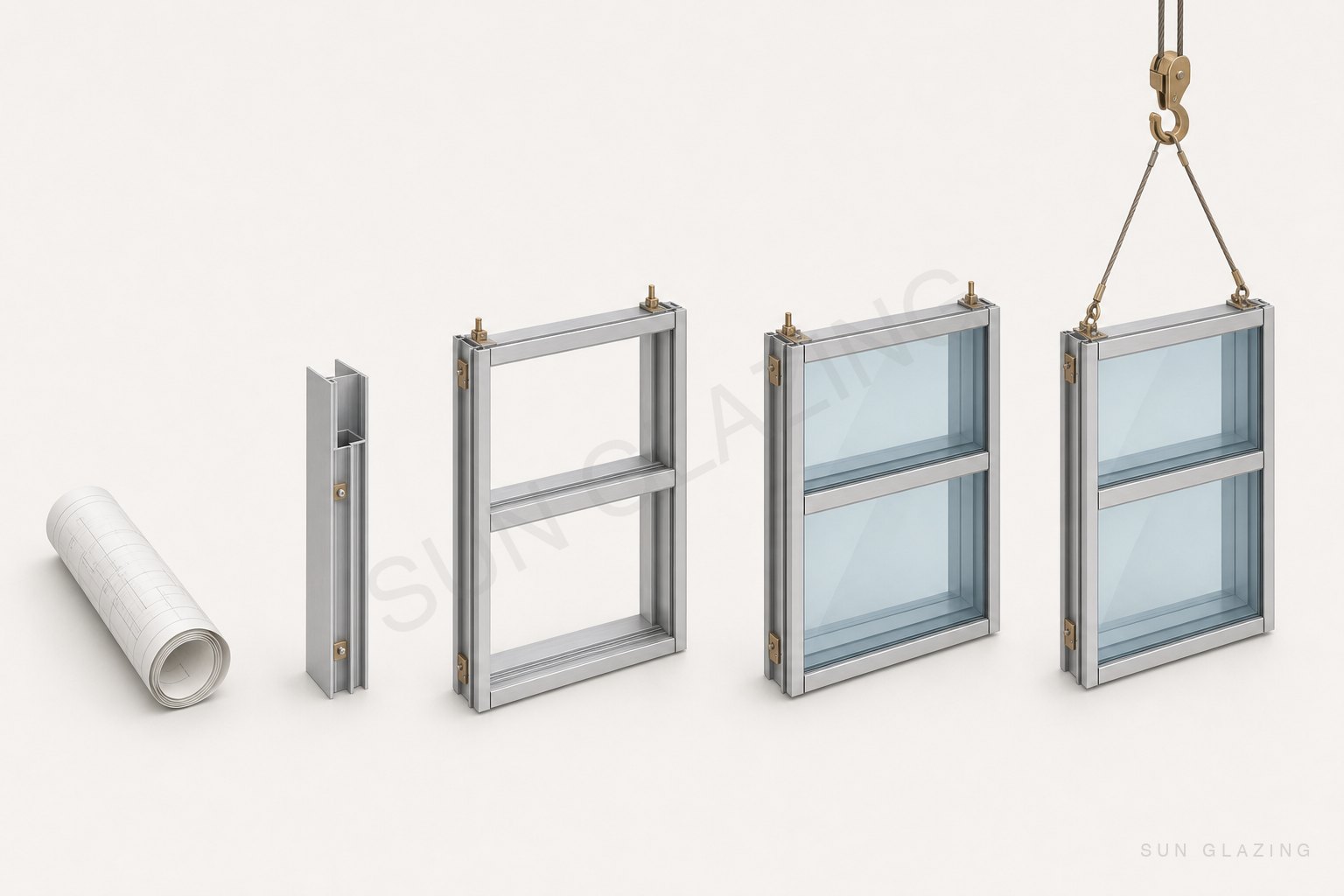
"Facade contractor" is a title many companies use and few fully inhabit. A glass supplier sells glass. A fabricator cuts and assembles what someone else engineered. An installation gang hangs what someone else built. A facade contractor takes responsibility for all of it — the engineering, the manufacturing, the installation, and the wall's behaviour for decades afterwards. Here is what that actually involves, stage by stage.
1. Design and engineering
The work starts long before aluminium is cut. The architect's intent — sightlines, shadow gaps, glass tones — has to become a buildable system: structural calculations against wind load, thermal and acoustic sizing, drainage paths, movement joints that absorb the building's own flex, and shop drawings for every panel type. On our projects this is done by our in-house design team, because outsourced engineering is where responsibility starts leaking.
2. Mock-ups before mass production
For every unique facade element we build a mock-up, and its drawings are approved by the facade consultant, architect, client and PMC before fabrication begins. A mock-up is cheap insurance: every disagreement about a joint or a finish gets settled on one panel instead of on eight hundred.
3. Fabrication
Extrusions are machined, assembled and glazed into finished panels on a factory line — in our case a 50,000 sq ft facility running Italian CNC machining centres and a triple-line dust-free glazing room. Factory conditions are the whole point: torque, sealant depth and squareness are checked at a bench, by QC staff, with instruments.
4. Performance testing
A serious contractor tests the wall before the building wears it — air infiltration, static and dynamic water penetration, structural deflection under wind pressure. The test rig is meant to find weaknesses; every failure in the chamber is a leak that never reaches the client.
5. Installation
Panels are delivered sequenced floor by floor and hung by installation crews with cranes, cradles and lifting gear — in our case our own installers, not a labour contractor meeting the system for the first time. Installation quality is the difference between a facade that performs like its test report and one that merely resembles it.
6. After-sales — the part everyone forgets
The facade outlives the project team. Gaskets age, buildings settle, tenants change doors. We back our walls with a 15-year warranty and a decade of aftercare, and we are still servicing facades we built fifteen years ago.
When you evaluate a facade contractor, ask one question about each stage: who exactly does this — you, or someone you hire? The more often the answer is "we do", the fewer gaps there are for quality to fall through. Ours is "we do" at every stage — see the buildings that resulted, or put a hard question to us directly.
← All posts