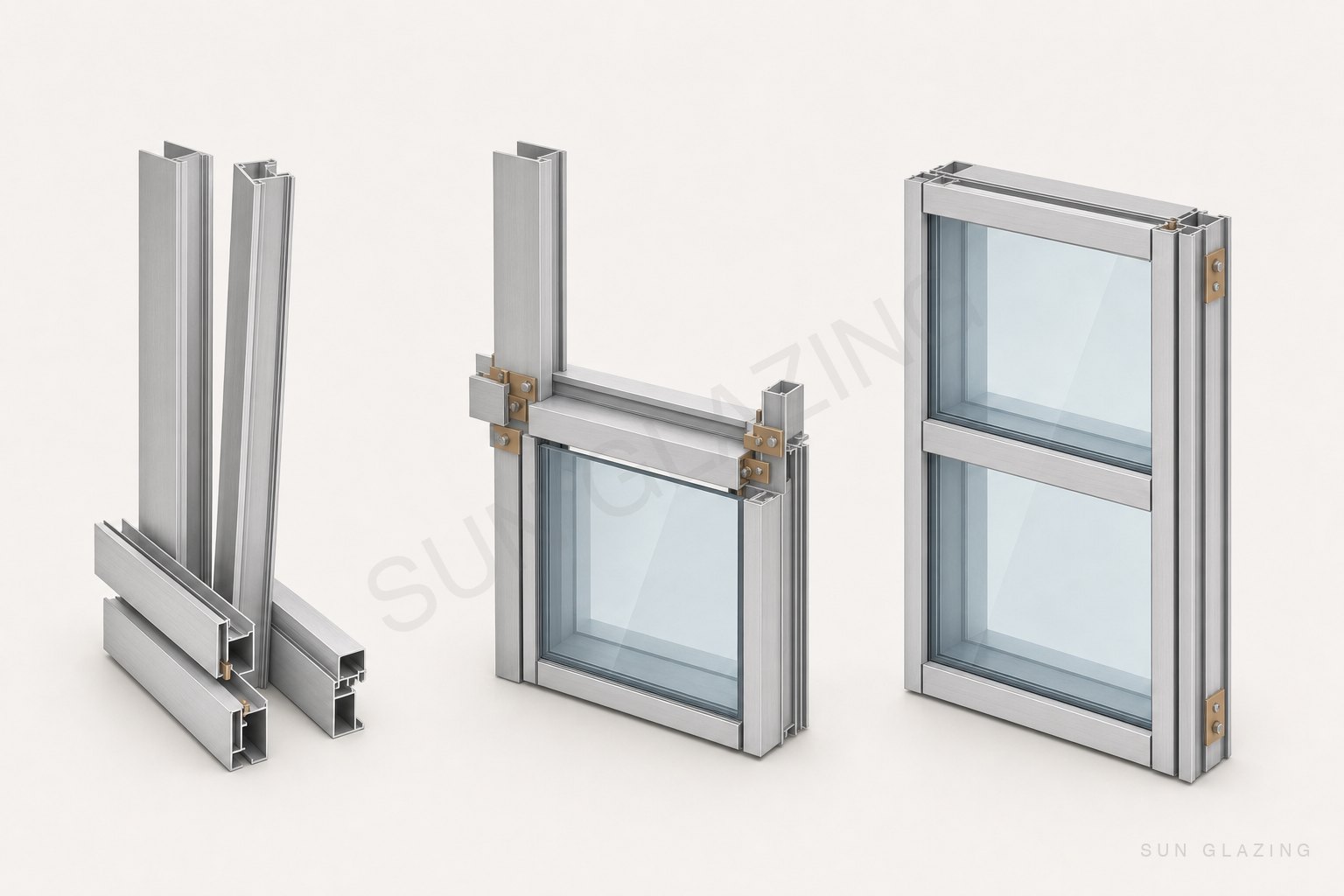
Almost every glass facade conversation in India eventually arrives at the same question: unitized, semi-unitized or stick? All three enclose the building. The differences are in where the facade gets built, how fast the building closes, and where quality is won or lost. Having engineered and installed close to seven million square feet across all three, here is how we frame the choice.
Stick systems: built on the building
In a stick system, the facade arrives as loose lengths of aluminium — mullions and transoms — that are assembled member by member on the structure, after which glass is fixed into the erected grid. It is the oldest approach, the most tolerant of irregular geometry, and the cheapest on paper for small or low-rise work.
The trade-off is that nearly everything happens at height, on scaffolding, in site conditions. Sealant lines are gunned in dust and wind. Quality depends on the discipline of the crew that day. For a boutique retail frontage or a low podium, that is often perfectly acceptable. For a tower, it rarely is.
Semi-unitized: the halfway house
Semi-unitized systems shift part of the work into the factory — typically the grid goes up stick-fashion, while glazed cassettes or shutters are pre-assembled and then fixed onto the grid. It reduces site glazing labour and improves the glass line, while keeping entry cost below fully unitized. Much of Hyderabad's commercial stock from the 2000s and 2010s was built this way, and we still deploy it where budgets and building height make it the sensible middle path.
Unitized: built in the factory, hung on the building
A unitized curtain wall is different in kind, not just in degree. The facade is manufactured as complete, glazed, gasketed panels — each one storey tall — on a factory line, delivered to site sequenced floor by floor, and hung on pre-set brackets. No scaffolding, dramatically less work at height, and every sealant joint made in a clean, dust-free glazing room rather than on the twentieth floor.
Three consequences follow. First, speed: floors close at a rate stick systems cannot approach, which pulls the whole project programme forward. Second, quality: factory assembly is measurable, repeatable and inspectable — you can reject a panel at a workbench, which you cannot do to a sealant joint forty metres up. Third, performance: interlocking male–female mullion joints with engineered drainage give unitized systems their superior air and water performance, which is why they dominate tall and premium buildings worldwide.
So which one?
- Under ~4 floors, simple elevation, tight budget: stick or semi-unitized will serve, honestly detailed.
- Mid-rise commercial with a real glass line: semi-unitized is the pragmatic floor; unitized is worth pricing.
- Towers, hospitals, airports, premium office: unitized — the programme savings alone usually pay the difference.
The honest answer also depends on the contractor. A unitized wall is only as good as the factory behind it — which is why we invested in a 50,000 sq ft plant capable of 750 sqm a day, and why we chamber-test our systems rather than assuming a good drawing equals a good wall.
If you are weighing systems for a live project, we would rather be in that conversation at concept stage than at tender — talk to us early.
← All posts