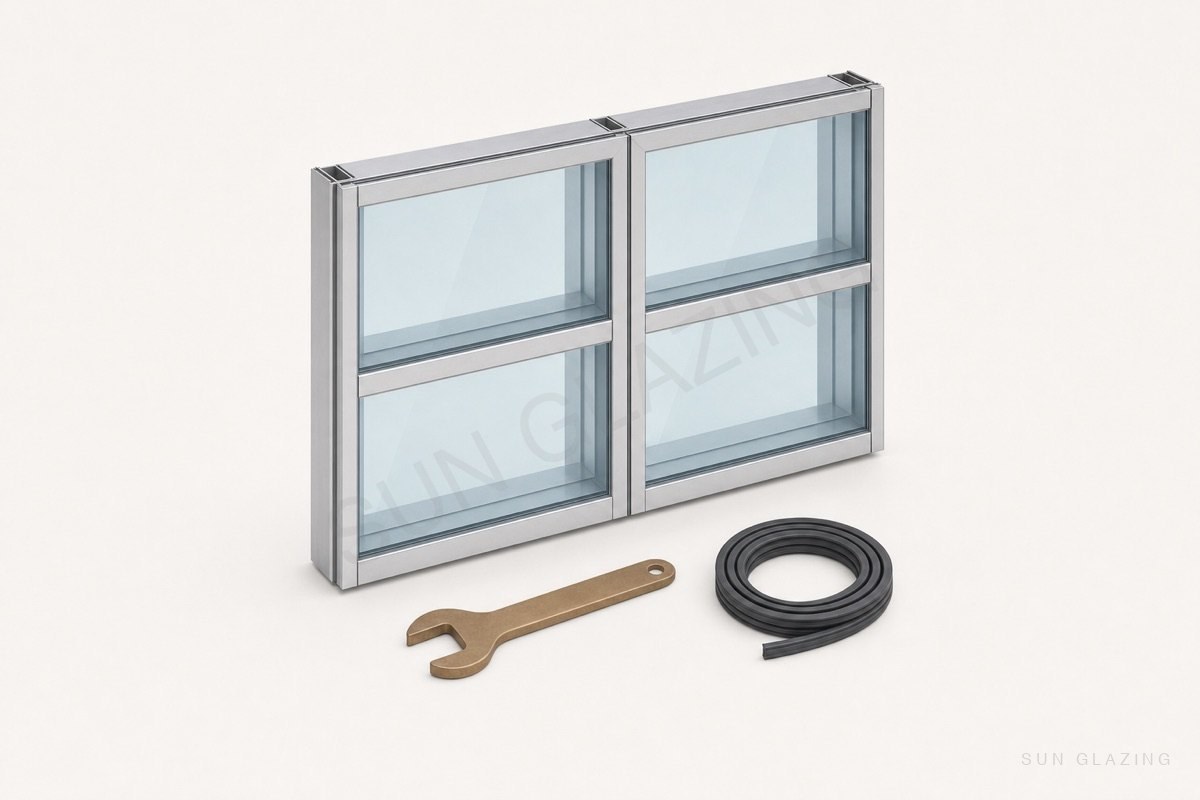
Developers ask us for the facade's price per square foot. Facility managers, ten years later, ask us a better question: how long will it last? The honest answer is layered, because a facade is not one material ageing at one speed — it is a system of components with very different lifespans, designed so the short-lived ones are replaceable.
The 50-year layer: aluminium and glass
Extruded aluminium doesn't rust, and its powder-coat or anodised finishes are genuinely long-lived. Glass, kept in a frame that drains properly, is effectively permanent. The structural logic of a well-engineered curtain wall — the mullions, the brackets, the anchorage — should outlive every tenant the building will ever have. This is the layer where cutting corners is unforgivable, because it cannot be economically replaced.
The 15–25 year layer: gaskets, sealants, hardware
EPDM gaskets slowly lose elasticity under UV and heat. Weather sealants have honest service lives of 15–25 years depending on exposure and quality. Door hardware, operable-window mechanisms and gaskets on moving parts wear with use. None of this is failure — it is the design. A unitized system's gaskets sit in accessible glazing pockets precisely so a maintenance team in year 20 can renew them without touching the structure.
What ageing actually looks like
Facades rarely fail suddenly. They whisper first: a stain track below one joint after heavy rain, a window that needs a shoulder, hairline sealant cracks at the most sun-hammered corner. Caught at the whisper stage, each is a small, cheap intervention. Ignored for years, water finds the interior finishes — and the repair bill multiplies by the floor area it damaged.
The maintenance regime that earns the lifespan
- Cleaning on a sensible cycle — not cosmetic; dirt holds moisture against joints.
- Annual visual inspection of sealant lines, weep holes and gaskets — half a day for a trained eye.
- Prompt glass replacement with the identical specification, not the nearest match in the bazaar.
- Decade review — a closer survey of joints and hardware at year 10–12, renewing selectively.
What the warranty should say
Ask three things of any facade warranty: how long, what exactly is covered, and who answers the phone. Ours is a 15-year system warranty with a decade of aftercare — and our record runs past the paper: we are still servicing facades we handed over fifteen years ago, on good faith, because the buildings carry our name on their skyline. When we say a facade is a 50-year asset, we are describing buildings we still visit.
If you are inheriting a facade — ours or anyone's — and want an honest condition survey, talk to us.
Frequently asked questions
How long does a glass curtain wall last?
The aluminium structure and glass of a well-engineered curtain wall are good for 40–50 years or more. The ageing components are the gaskets, sealants and hardware, which have 15–25 year service lives and are replaceable — a facade is maintained into old age, not replaced.
What maintenance does a curtain wall need?
Routine cleaning, an annual visual inspection of sealant lines and drainage, prompt replacement of damaged glass, and a closer joint-and-gasket review after the first decade. It is a light regime — but skipping it for twenty years is how leaks are born.
← All posts