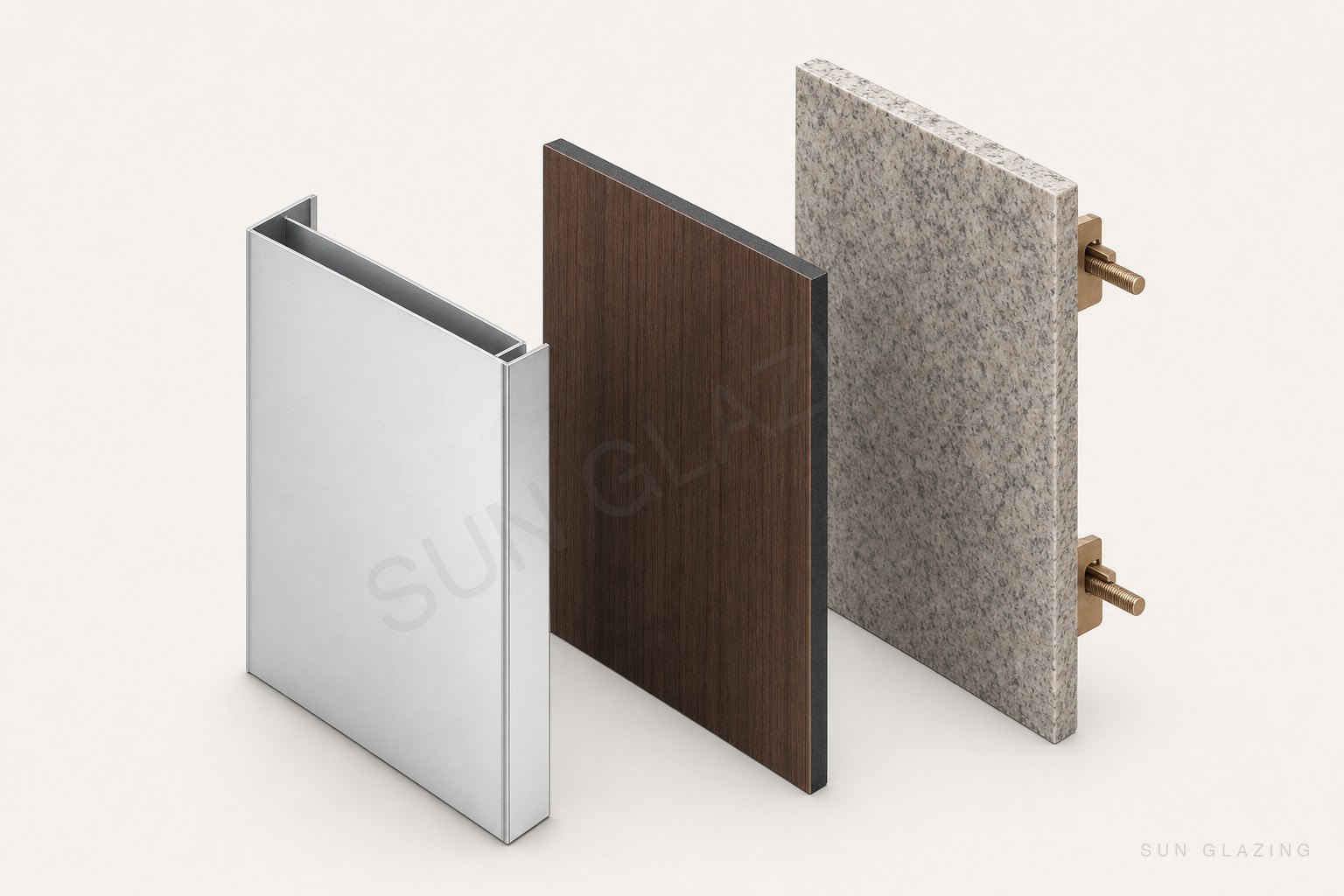
The solid parts of a facade — the spandrels, cores, feature walls — get decided late and argued about often. ACP, HPL or stone is usually framed as a taste question. It is really an engineering and lifecycle question, and each material deserves an honest account.
ACP: the workhorse
Aluminium composite panel — two thin aluminium skins over a core — is light, flat, foldable into crisp trays, and available in almost any finish. It is the most economical route to a sharp, modern solid facade and the easiest to fabricate precisely. The one question that matters more than colour: the core. Standard polyethylene cores burn; fire-retardant (FR) mineral-filled cores are the responsible default, and post-Grenfell no serious contractor should quote anything less on a tall building. Specify the core class in writing.
HPL: warmth without timber's problems
High-pressure laminate — resin-impregnated kraft layers cured under heat and pressure — delivers convincing timber and matte finishes with far better UV and moisture behaviour than real wood. It is heavier than ACP, needs edge detailing (the black core shows at cut edges, which good design embraces), and premium exterior grades matter: the cheap boards grey and bow within a few monsoons. On ventilated sub-frames it makes handsome, tactile facades for low and mid-rise work.
Stone: permanence, at a price
Granite and other stones age better than anything man-made — but at 60–80 kg/m² and up, stone is a structural commitment. It demands engineered sub-frames with undercut or kerf anchors (never adhesive alone at height), generous brackets back to structure, and honest wind-load work. Done right, it outlasts the building's first two tenants put together. Done as an afterthought, it is the heaviest thing that can fall off a building.
The part nobody photographs: the sub-frame
Here is the trade secret: the visible material is rarely what fails. The aluminium rails, brackets, and anchors behind it — and the drainage cavity they create — decide whether the cladding stays flat, stays dry and stays on. We engineer the sub-structure with the same calculations as our curtain walls, whichever skin goes on it. When comparing cladding bids, ask to see the sub-frame drawings; the cheap quote usually has the flimsy one.
Choosing in practice
- Budget-driven, large areas, crisp look: FR-core ACP on an engineered rail system.
- Warmth, texture, human scale: exterior-grade HPL, detailed for its edges.
- Landmark permanence, ground-floor gravitas: stone, engineered properly.
- Most real buildings: a combination — and a contractor who can integrate all three on one sub-frame logic rather than three subcontracts.
We fabricate and install all three in-house, which makes us material-agnostic: we will tell you when ACP is the right answer even if stone was the bigger invoice. Bring us the elevation and we'll walk the options with samples on the table.
← All posts